Could sport become a sustainable business practice in Africa? Well, it is a question I have been asking myself for a while. Africa currently has a unique momentum for sport business.
When I say sustainable, I mean an industry that still makes money and creates jobs when the tournament is over. Local leagues, clubs and companies need to get a real share of it.
A unique window until 2030
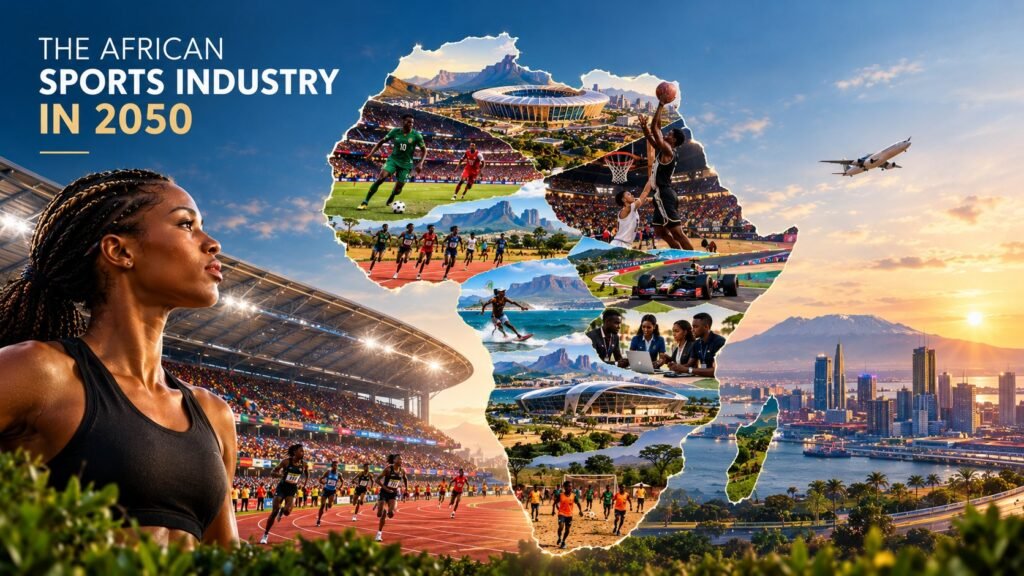
When it comes to events, the first Olympic event on the continent, the Youth Olympic Games, is happening in Senegal from 31 October to 13 November 2026 [1]. The first World Athletics Championships on the continent will take place in Kenya in 2029 [2]. The FIFA World Cup will be co-hosted by Morocco, Spain and Portugal in 2030 [3]. And more recently, Formula 1 is coming back to Africa with the African Grand Prix, to be hosted in Rwanda under a ten-year deal, the first F1 race on the continent since 1993 [4].
All of these events may justify that the African sport industry has a unique launch window from now until 2030, for a long-term bet until 2050. But is it enough to make sport a sustainable business practice in Africa? To answer this question, we need to look at the numbers and see what they really represent.
The numbers: audience and TV rights
TV rights are one of the main sources of revenue when it comes to sport. Africa’s population is expected to more than double by 2050 and pass 2 billion [5], and about 60% of Africans are under 25 today [6]. This represents an amazing human capital that sport could capture, taking into consideration also the people watching from outside Africa. So basically, we will have the population to watch and even trained people to work in the industry. But young people watching do not bring money by themselves. Someone has to pay for the subscription, the ticket or the sponsorship. So it is still not enough.
The product, and the limits of one-off events
The product, whether it is football, motorsport or basketball, should be able to capture that. Let’s assume it does. Look at the commercial and TV performance of the recent TotalEnergies CAF AFCON Morocco 2025. CAF reported a revenue increase of more than 90% and 23 sponsors, up from 17 in 2023 [7], and beIN SPORTS says it reached more than 3.45 billion cumulative viewers across TV and digital [8].
African football is clearly more attractive when it comes to national teams, but a big audience does not mean the money stays in Africa. The 97.3 million viewers of the final, for example, were counted in beIN’s MENA markets [8]. Local clubs, basically the heartbeat of African football when we take a business approach to sport, are far behind. The squads of the two most valuable leagues in Africa, Egypt (about €174 million) and South Africa (about €156 million), are worth around 1% of the English Premier League (€12.56 billion) [10]. Morocco is starting to move, with a record Botola Pro budget of MAD 965 million approved in July 2026 [11].
This example shows that having punctual or one-shot events does not necessarily reflect local economic growth, and does not by itself make sport a sustainable business practice.
My take: a political decision
My personal take is that making sport a sustainable business practice in Africa is mainly a political decision. While governments build the framework, they should also keep in mind to attract the top talent in the sport industry in Africa. For me, this is the best way to create sustainable growth.
To understand this, we need the big picture of how a single mega event can boost sustainable growth. For example, for the FIFA World Cup 2030, Morocco has launched many infrastructure works, from hotel construction to new airport terminals. The government plans to spend 38 billion dirhams on its main airports and to raise capacity from 38 to 80 million passengers by 2030 [9], and the entire country is preparing to host the event [3].
While this is mainly transversal and a consequence, it also benefits the sport industry itself. First, the legacy, such as stadiums and infrastructure, will benefit the development of football. But it also helps local actors position themselves in the value chain of sport in Africa, as they will capture revenue from the event. And all of this starts with just a vision: organizing the FIFA World Cup. The same principle could apply to making sport, and more globally the creative industries, a leading sector.
A mega event does not guarantee anything, though. After the 2010 World Cup, South Africa was left with five new stadiums that cost about R12 billion, several of them with no anchor tenant. The four that published their costs run at about R104.5 million a year [12]. So the real question is what happens to the infrastructure after the tournament, and that has to be planned before it.
If I had to start somewhere, it would be with professional leagues and clubs that are well run, so the money stays local all year. Then stadiums with a plan and a calendar of competitions before the event, and not after. And then people: sport managers, marketers and operators trained and kept in Africa.
The challenges, and the way forward
Admittedly, regarding the current situation in Africa, we understand that sport cannot be a priority for many countries. Industrialization, health, security, food insecurity and access to electricity are the main challenges governments face, and I understand how hard it can be to address such a complex map.
Still, I think that if we want to close the gap with Western countries, we cannot take the exact same road. We need to address our problems simultaneously, with a dedicated workforce for each of them. With the right talent, as mentioned earlier, we could, under these conditions, make sport a sustainable business practice in Africa.
Sources
- 2026 Summer Youth Olympics, Wikipedia
- Nairobi to host 2029 World Athletics Championships in historic first, The New Times
- Mondial 2030 : où en sont les grands chantiers engagés par le Maroc, Hespress
- F1 to host African Grand Prix in Rwanda, ABC News (14 October 2026)
- 2050 population projections, Population Reference Bureau (2017 data)
- 5 facts about Africa’s population growth, Pew Research Center, based on UN data (May 2026)
- CAF reports 90% revenue surge from AFCON 2025, Yabiladi (16 January 2026)
- beIN SPORTS reveals record-breaking 3.45bln cumulative viewership, Zawya
- Morocco to spend billions on World Cup airport expansions, The New Arab
- The most valuable football leagues around the world in 2026 (squad market values), Win Sports Online (January 2026)
- Botola Pro approves MAD 965 million budget, Morocco World News (July 2026)
- Stadiums score costly own goals, Mail & Guardian (June 2011)